Desktop Explorer
Game details
- Released
- Developer
- Recurring Dream
- Publishers
- indienova, Outersloth, Recurring Dream
Play details
- Started
- Completed
- Platform
- Steam
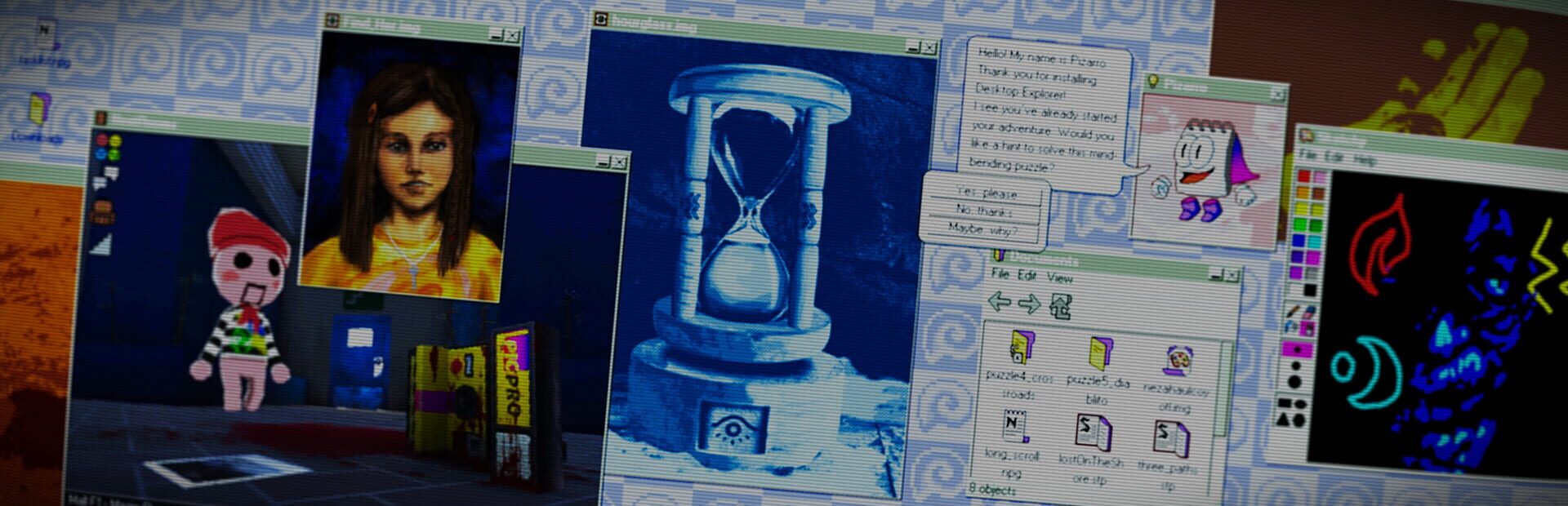
Desktop Explorer is a narrative-driven puzzle game wrapped up in a computer desktop simulation. The concept and puzzles are good, and the pacing was also good -- however, the narrative got pretty weak near the end. It was still worth playing, and I would still recommend it to people, assuming they can look past the flaws in the storytelling.
What I Didn't Like
Weak Storytelling
For the first half of the game, this wasn't an issue. You start going through this computer and learning about its users, and you try to figure out what happened to them, as they all seemed to have various problems they were dealing with.
Without spoiling anything, I can say that the reveal of the cause didn't align with the rest of the storytelling, which is why I found it weak. In a story that is so grounded in real people having real problems, it didn't feel like it fit with the context of the world they had built throughout my playthrough.
Beyond the reveal of the culprit, there were a couple of tropes used in the storytelling that are not very original. Again, no spoilers, but a lot of spooky narrative-driven games fall back on these tropes. In my opinion, that sort of thing cheapens the experience overall and leaves the player feeling unsatisfied with the result.
Repetitive Puzzle Mechanics
This might be a limitation of this sort of desktop simulation gameplay, but the game mechanics became a little repetitive after a while.
When my partner and I play games, we take our time. We explore everything, we look at everything, and we try to solve everything we come across. This means we spend quite a bit of time reusing and combining these mechanics. The thing is, after a while, if the lore doesn't add more to the experience (which it didn't), then we rely on the puzzles and the mechanics to make it more interesting.
For the first half they were fun, but after that, they became repetitive. We got to a point where it felt like we were on autopilot while solving the puzzles, which would be good if the storytelling was bethe tter (see above).
What I Liked
Progression and Pacing
Yet again, no spoilers -- but once you solve one of bigger mysteries of the game, it opens up another. At this point, there is a part of my brain that was just done with the game, and I wanted to move on. This happens to me with deduction-style games as well, and although I hit that point in this game, a break for a couple of days, combined with a speedup in the pacing, led to me really enjoying the latter part of the game (as opposed to feeling like I'm forcing it).
Yes, they introduce some new gameplay -- which, when introduced in the latter half of a game, generally annoys me. But they make it simple enough and speed up the pacing of the storytelling so you can fill in the blanks you were left with in the earlier part of the gami.
I clearly didn't love the storytelling (see above, again), but I did enjoy how they moved us along, almost knowing that we had spent enough time in the game and needed to put it to rest once and for all.
Conclusion
Desktop Explorer is an interesting video game. One that I would probably have gone back to later if the storytelling had been better and kept me hooked. In my playthrough, I managed to get only about half of the achievements. According to Steam, there are 8 more secret achievements I have yet to find.
However, I don't have an interest in returning to this world. It had a satisfying enough ending, but the narrative journey just didn't do it for me.